Emerald Marquis 91: One Of WGI's Most Influential Shows Of All Time
Emerald Marquis 91: One Of WGI's Most Influential Shows Of All Time
In this ongoing series, Courtney Allyson Mills takes a look back at some of WGI's most influential shows—this time, it's Emerald Marquis.
Unlock this article, live events, and more with a subscription!
Already a subscriber? Log In
Groundbreaking shows are not always the ones that finish first, but they always have a lasting impact on the direction of the sport many years after their final performance.
In this ongoing series, FloMarching has asked one of color guard's top experts, Courtney Allyson Mills, to take a look back at some of WGI's most influential shows.
Courtney Allyson Mills has taught color guard and dance at over 150 high schools and universities. A two-time WGI gold medalist with The Company and a DCI finalist with Carolina Crown, she is also the founder and facilitator of ColorguardEDU.
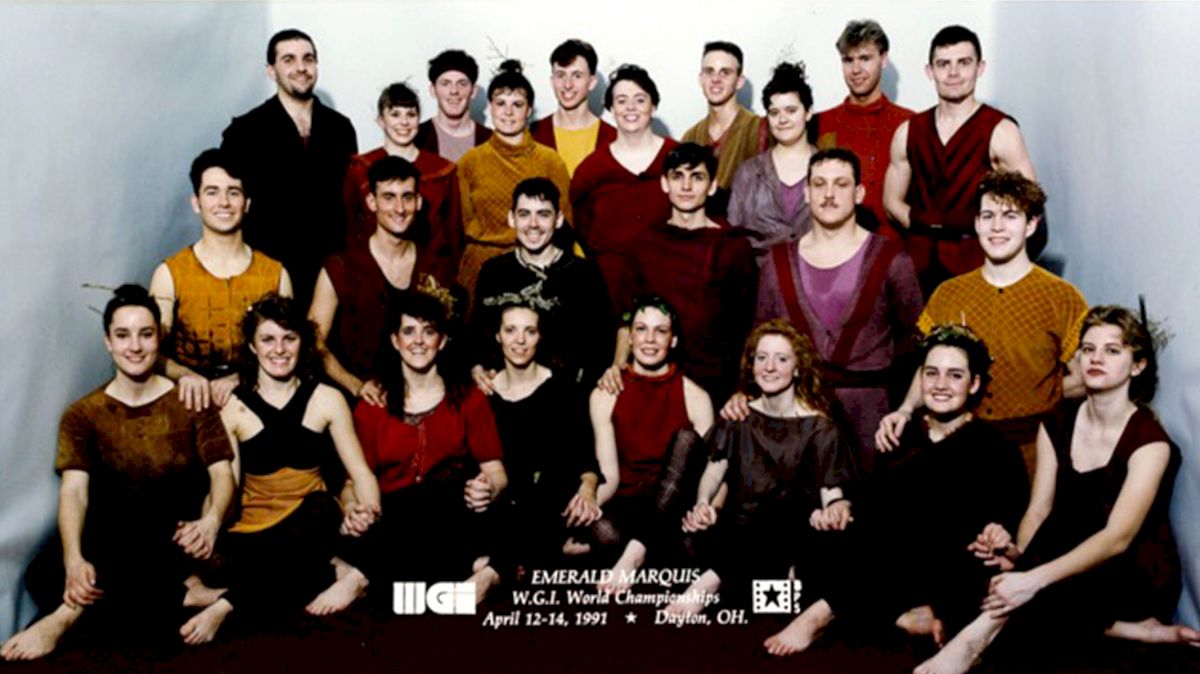
Emerald Marquis 1991
The performance takes place on a simplistic set, with twigs and branches placed behind a cream-colored floor. The cast, men and women wearing earthy colors, are scattered around the floor in the opening set. From the very first note of the music, there is an energy on the floor. It’s intense, sensual, and exciting.
In 1991, Emerald Marquis brought something to the WGI arena that was felt in the community for years to come. This show bridged staging vs. drill and stillness vs. motion in a way that honored the past and gave a glimpse into the future. The performers were engaged with the show, with each other, and held captive an audience on the edge of its seat.
The beginning of the show is composed of duets, vignettes, motion, and stillness — creating stages for different shapes and events. There is no equipment, just bodies moving in a brilliantly choreographed, stylized, and modern fashion. The feeling is light and the performers do an excellent job of taking the audience on a journey from start to finish.
As the first act concludes, there is a duet centered on an empty floor. A loving kiss is exchanged and then a brief silence. Kate Bush’s “Jig of Life” then fills the space, as do the performers, with an intensity that is in stark contrast to the opening movement piece. Immediately, the floor swirls with rifles, sabres, and flag vignettes that build into bigger moments that each resolve and lead to a new idea.
And just like that, the floor is empty again, with a solo sabre performer (KC Perkins) front and center, doing a jig, shifting the mood, and letting the audience catch its breath. Each section takes turns being featured: first the sabres, then the rifles, and last the flags, which become an add-on flag feature.
But this isn't just any flag feature. Within this phrase, the performers manipulate the shaping of the silk with their lower legs, ambidextrously. The choreography is filled with direction changes, three-dimensional work, and ends with a right-handed double. While that may not seem too different from what we see now, in 1991, it was VERY different and incredibly difficult.
The show did not end with that double. In fact, the show didn’t end with a flag feature at all.
With a full minute left on the floor, Emerald Marquis creates an ending never to be forgotten. It seemed like the music got faster and faster, but it was the performers who were moving their bodies and equipment at an incredible rate of speed through drill move upon drill move. What was even more impressive was the accuracy they were achieving through drill and equipment within this last minute.
And then it abruptly ends as the performers make their way into a grid, turn around, and walk off the floor. No ending flag feature, no moment to take in the audience — an unexpected ending to an incredible show. As the performers are exiting the arena, they’re not looking over their shoulders to the audience. Instead, they’re embracing each other with exhaustion that lets everyone know that they left it all out on the floor.